
The Ancestral Map: How Geography and Property Records Solve the Mysteries of Your Family Tree

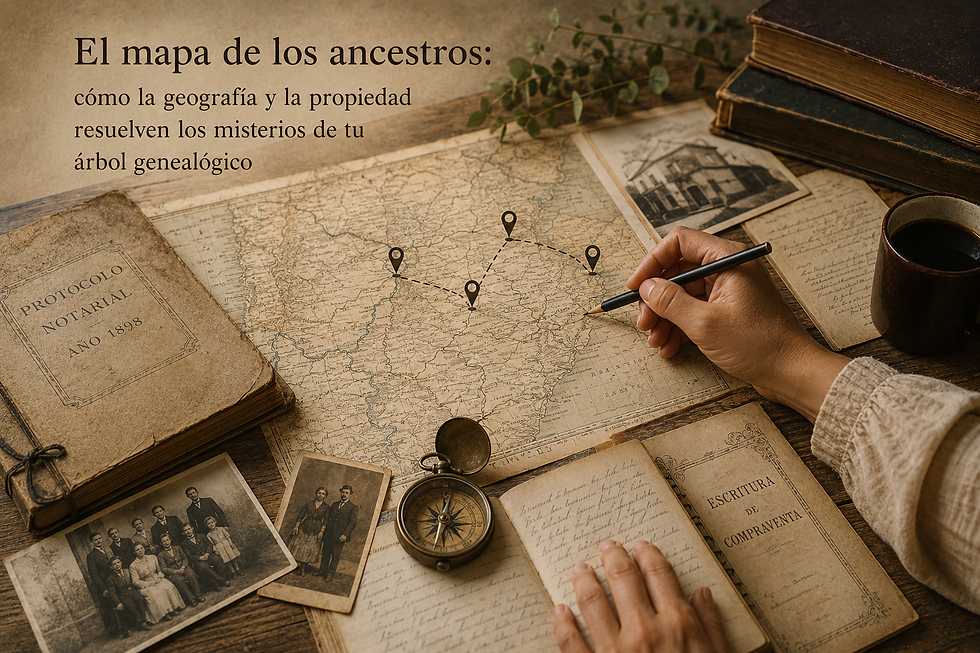
When we begin researching our family history, the natural tendency is to look for birth, marriage, and death certificates. We follow a straight line of names and dates. But what happens when records are burned, lost, or simply don't add up? That's where geographical and registry genealogy comes to the rescue.
The places our ancestors inhabited weren't just coordinates on a map; they were the stage for their lives, their businesses, and their secrets. Through three real-life cases, we'll discover how geography and property deeds can reveal connections that official records sometimes leave unsaid.
1. Microgeography and Traditions: The Hen Feast
Imagine finding a 19th-century marriage between two people born in completely separate towns, with no apparent connection. In an era when people rarely moved from their place of origin, how did they meet?
The answer isn't always found in trade routes, but rather in the festive calendar. By studying the local geography and regional traditions, we discovered that the two villages, separated by official roads but very close across the farmlands, shared an annual festival at a midpoint. The Hen Festival, a rural tradition, was a strategic geographical meeting point, the Tinder of its time. Analyzing the environment and local customs allowed us to understand "how" and "where" a family was born.
2. The Deed of Sale: Tracing the Roots of a Home
Sometimes, to understand a person's past, you have to look at the present of a house. Tracing current ownership back in time is one of the most powerful tools of genealogy.
By following the thread of an old deed of sale, we not only discover who paid for the land, but also the family network that supported that transaction. Deeds often cite neighbors, witnesses, or former owners who turn out to be uncles, grandparents, and cousins of the current owner, especially when the property has been inherited for generations. The property had remained within the family circle to protect the inheritance, turning the notarial documents into a hidden family tree.
3. The Secrets of Inheritance: When Property Reveals the Truth
The most striking example of how the geography of a property unearths the truth occurs in inheritances. The transfer of a farm from a father to a daughter seems, at first glance, a clear biological line. However, the legal documents of the time required absolute precision to avoid future litigation.
It is in the fine print of an inheritance partition or donation where the surprise suddenly emerges: the heir was, in fact, an adopted daughter. A family secret, jealously guarded in the family's oral tradition, was revealed thanks to the legal requirement to specify the origin and rights to a property. The land doesn't lie.
Three lessons for your research:
Don't just look at the name, look at the place: Investigate the roads, markets, and religious festivals that connected neighboring towns.
Consult the Land Registry and notary records: Purchase deeds, wills, and dowries have more human and familial context than many civil records.
Cross-reference data: A piece of land that changes hands suspiciously quickly or without any money changing hands often hides a blood tie (or legal bond) that deserves to be investigated.
The next time you get stuck on your family tree, unfold a map from that era and look for property titles. Names may fade with time, but the land always holds the memory of those who deciphered it.
Would you like us to do it for you?
At DNA and Genealogy, we have used these types of methodologies to solve complex cases, reconstruct family trees, identify heirs, document family histories, and trace the history of properties in Chile and abroad.
If you want to learn the history of a house, a plot of land, a family property, or discover what secrets its associated historical records might hold, we invite you to explore our Property History service.
👉 Discover more here: https://www.adnygenealogia.cl/historia-de-la-propiedad
Because sometimes, the best way to find our ancestors is to follow the trail of the places they called home.


Comments